By Chris Simmons
This off-season, the Ravens experienced an exodus of players from their Super Bowl winning team. Meanwhile, the Orioles made no major moves, content to utilize the same roster that many pundits thought overachieved last season.
In both Major League Baseball and the National Football League, players have unionized to bargain for their working conditions. Until the 1970s, player movement and salaries were severely restricted in both sports, as one team owned a player's rights unless it decided to get rid of the player.
That has changed in recent years. These new working conditions and rules are complied in a collectively bargained agreement, signed by both the leagues and the unions. Many of these rules influence how teams build their rosters.
In baseball, the player agreement allows for free agency after six years of service time. But prior to free agency, when a player can sell his services to the highest bidder, a player can go to salary arbitration to settle any disputes with a team over a salary. It is a nuanced area, but in general, the player has this right to do so when he has played at least three years, but less than six. However, if a player spends at least 82 days on a roster in his first year, he can be eligible for arbitration after his second season.
This has led teams to hold Major League-ready players down in the minors for the first few months of the season to avoid starting their arbitration clock a year early. This could potentially save a team millions, as most rookies will only make about $500,000 per year.
Many teams are now buying out those arbitration years before a player gets there, by giving long-term contracts to young players. This gives the player more long-term security, while giving the team a cheaper rate over that period.
Rather than dabble in free agency, this appears to be the Orioles' approach: develop a young core and spend to secure their rights early while building with cost-effective players in other positions. The Orioles have already locked up Adam Jones to a long-term deal, and will likely attempt to do the same for Matt Wieters and Manny Machado.
The Ravens have taken a similar approach since the newest collective bargaining agreement was signed in 2011 after a lockout of the players by the owners.
The new CBA implemented a rookie wage scale. Before this iteration of the bargaining agreement, teams were free to make rookies some of the highest players in the league. Now the league limits how much money teams are allowed to spend per year and all players are given four-year deals, with first-round picks getting a fifth year option.
These contracts are now slotted with a certain value, at significantly less money than veterans earn (the agreement also gives veterans a higher minimum based on their years played). This has led teams to cut non-Pro Bowl veteran players who can be cheaply replaced with players on rookie deals. Teams would rather pay younger players less money and retain control over their rights than keep higher-paid veterans.
This may help explain why the Ravens traded Anquan Boldin for a sixth-round pick. Boldin was set to make $6 million per year. The Ravens' first-round pick this year, the 32nd in the drafted, has been slotted at four years for a total of $6.7 million over the total length. This means that the Ravens' pick, Matt Elam, will be forced to accept a deal for approximately that value because of the rules limiting the amount of money teams can spend on rookie players. The Ravens were simply building in the way the new collective bargaining agreement dictates: give expensive deals to players you cannot replace, but seek cheap, young replacements for nonessential veterans.
It's easy to see how both teams reached their conclusions on the best way to structure their rosters. All they had to do was look to the bargaining agreement.
Showing posts with label Baltimore But Still.... Show all posts
Showing posts with label Baltimore But Still.... Show all posts
Wednesday, May 29, 2013

Tuesday, May 7, 2013
A Confederate Memorial in Baltimore

 |
| Ruckstull, Frederick Wellington, Confederate Soldiers and Sailors Monument, 1903 |
On Mount Royal Avenue, just a few blocks south of West North Avenue, sits Frederick Wellington Ruckstull’s 1903 Confederate Soldiers and Sailors Monument. Depicted is a winged goddess of victory with flowing vestments and up-opened wings. With her left hand high, she clutches a laurel wreath in an act of solemn presentation. With her right arm, she braces a dying Confederate soldier, giving him support as his one hand grips his chest, and his the other hand holds the battle standard of the Confederacy, tip pointing slightly downward. The soldier’s head is tilted toward the bosom of the goddess and the eyes on his weary face are closed—perhaps the last fitful moments of the young soldier's life. Among the inscribing upon the sculpture’s plinth are the Latin words Gloria Victis (“glory to the vanquished”), Deo Vindice, (“God vindicates”), and the phrase "Glory stands beside ov'r grief."
Let’s make sure we get this right. God vindicates . . . the Confederacy?
 |
| Buberl, M. Caspar, Appomattox, 1889 |
I think Buberl's monument utterly suits the subject that it seeks to memorialize. It doesn’t glamorize the Confederacy, or whitewash its horrors. Quite the contrary; the veteran could just as easily be standing over the graves of dead comrades as he comes to the realization that the Confederacy fought for a benighted end. Erected by the Robert E. Lee Camp of the United Confederate Veterans, the sculpture nevertheless speaks to a far larger audience than those who identified themselves with the Confederacy. An emancipated slave, now proud and independent in his freedom, could easily have have looked upon the work and been moved by it. The emancipated slave could easily have seen a veteran who fought for a lost cause—and a man whose dedication now recoils upon him.
 |
| Confederate Soldiers and Sailors Monument, detail. |
In contrast, Ruckstull's far larger monument seeks little more than to propagandize the glory of the Lost Cause of the Confederacy. It's not surprising given Baltimore's southern sympathies during the Civil War, but its statement in the present moment is jarring. And consider that Ruckstull even depicts a man in his last moments of life. Ruckstull's work depicts the more graphic and tragic horror, but his depiction manages little more than to trivialize it.
 |
| Appomattox, detail. |
According to the New York Times' coverage of a speech Ruckstull gave before the people of Boston in 1903 and the same year of his Soldiers and Sailors Monument, Ruckstull believed that “the functions of open air statuary are to delight, to refine, to console, to stimulate.” These are worthy goals for public art. It’s a shame then that Ruckstull's own monument here in Baltimore did not live up to his stated ambition.
Friday, April 19, 2013
Baltimore's Costly Cars
By Dean Fleyzor
In 2011, Baltimore's Labor Day Weekend inaugural Grand Prix left the city in a tough financial position. Initially, the Baltimore Sun claimed that the races were a success because profits for hotel revenue in the downtown area increased by $270,000 and food and drink sales increased by $155,000 compared to 2010's Labor Day Weekend. Although the 160,000 attendees at Baltimore's first Grand Prix in 2011 brought money into the city, the event amassed $47 million due to the increased presence and spending of tourists. However, the races failed to bring in $23 million needed to meet the city's goal of $70 million from hotel, food, entertainment and shopping revenues.
The impact of this past Labor Day Weekend’s Grand Prix may never be fully known. According to the Baltimore Sun, in September 2012, Mayor Stephanie Rawlings-Blake said Baltimore would not conduct an "economic impact study" of the race's revenues to the city.
Unofficial estimates report that the impact of the race in its second year was around $42 million, a 10% drop from the inaugural Grand Prix. While the official numbers may never reveal the failure of Baltimore’s second Grand Prix, there might have been some positive impacts to the city. Anirban Basu, owner of an economic policy-consulting firm in Baltimore, told ABC News that the Grand Prix "continues to be a risk for Baltimore but the reward may eventually be priceless."
The race could possibly grow in reputation in the coming years, and eventually see profit. Basu noted that if the racetrack could be redesigned to induce more people to walk to Federal Hill or Little Italy, the economic impact could dramatically increase. Some changes were already implemented after the Grand Prix in 2011, such as efficient exits for spectators and race times that increased the impact of tourism downtown. The city has a contract to host the Grand Prix races through Labor Day 2015.
Tom Noonan, President of Visit Baltimore, said he saw an increase in the number of organizations interested in holding conventions in Baltimore after the Grand Prix began. So there may be a silver lining in the underwhelming Grand Prix after all. If the races can attract the eye of more investors, the short-term financial loss may increase the chance that Baltimore will host more large events in the future.
In 2011, Baltimore's Labor Day Weekend inaugural Grand Prix left the city in a tough financial position. Initially, the Baltimore Sun claimed that the races were a success because profits for hotel revenue in the downtown area increased by $270,000 and food and drink sales increased by $155,000 compared to 2010's Labor Day Weekend. Although the 160,000 attendees at Baltimore's first Grand Prix in 2011 brought money into the city, the event amassed $47 million due to the increased presence and spending of tourists. However, the races failed to bring in $23 million needed to meet the city's goal of $70 million from hotel, food, entertainment and shopping revenues.
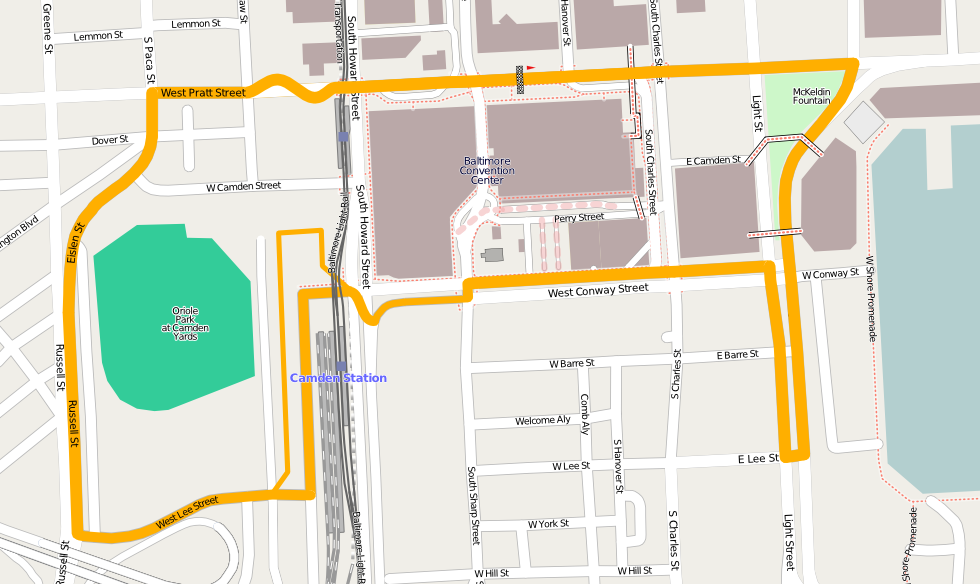 |
| 2011 map (from Wikimedia Commons) |

Unofficial estimates report that the impact of the race in its second year was around $42 million, a 10% drop from the inaugural Grand Prix. While the official numbers may never reveal the failure of Baltimore’s second Grand Prix, there might have been some positive impacts to the city. Anirban Basu, owner of an economic policy-consulting firm in Baltimore, told ABC News that the Grand Prix "continues to be a risk for Baltimore but the reward may eventually be priceless."
The race could possibly grow in reputation in the coming years, and eventually see profit. Basu noted that if the racetrack could be redesigned to induce more people to walk to Federal Hill or Little Italy, the economic impact could dramatically increase. Some changes were already implemented after the Grand Prix in 2011, such as efficient exits for spectators and race times that increased the impact of tourism downtown. The city has a contract to host the Grand Prix races through Labor Day 2015.
Tom Noonan, President of Visit Baltimore, said he saw an increase in the number of organizations interested in holding conventions in Baltimore after the Grand Prix began. So there may be a silver lining in the underwhelming Grand Prix after all. If the races can attract the eye of more investors, the short-term financial loss may increase the chance that Baltimore will host more large events in the future.
Saturday, March 9, 2013
Charming on the football field and the dance floor?
By Anna Pishko
Charming on the football field and the dance floor?
Baltimore Ravens wide receiver Jacoby Jones is no stranger to dancing in the spotlight. But he is usually dancing in the end zone, not in a ballroom. That is set to change to when "Dancing with the Stars" premiers this month on ABC. Jones will get the chance to show the world whether his dance moves on the field can translate into ballroom finesse and style.
Football players, especially wide receivers, so far have an excellent track record in the ballroom. Past winning dancers include Hines Ward of the Pittsburgh Steelers, Emmitt Smith of the Dallas Cowboys, and Donald Driver of the Green Bay Packers. But viewers of the show know it takes more than musicality and fancy footwork to win the coveted Mirror Ball Trophy. If you want to win over the fans, it takes a great personality. Jones has already charmed Charm City, but can he charm the rest of the country?
Karina Smirnoff, his assigned pro, will help Jones accomplish this mission. Karina is a long time pro on the show and a past winner. But fans might recognize her more for her personal life off camera (in the past five years she has had two high profile broken engagements and was rumored to be dating previous contestant Mario Lopez). Fans either love or hate Karina, which is something that Baltimore can certainly relate to.
Will these two have what it takes to make it to the finals? Will Charm City lend its charm to the dance floor? Will Karina and Jacoby be engaged by the time the show is over? Join us here each week as we attempt to answer these questions and give you a recap of their performance. We’re in for an interesting ride!

Charming on the football field and the dance floor?
Baltimore Ravens wide receiver Jacoby Jones is no stranger to dancing in the spotlight. But he is usually dancing in the end zone, not in a ballroom. That is set to change to when "Dancing with the Stars" premiers this month on ABC. Jones will get the chance to show the world whether his dance moves on the field can translate into ballroom finesse and style.
Football players, especially wide receivers, so far have an excellent track record in the ballroom. Past winning dancers include Hines Ward of the Pittsburgh Steelers, Emmitt Smith of the Dallas Cowboys, and Donald Driver of the Green Bay Packers. But viewers of the show know it takes more than musicality and fancy footwork to win the coveted Mirror Ball Trophy. If you want to win over the fans, it takes a great personality. Jones has already charmed Charm City, but can he charm the rest of the country?
Karina Smirnoff, his assigned pro, will help Jones accomplish this mission. Karina is a long time pro on the show and a past winner. But fans might recognize her more for her personal life off camera (in the past five years she has had two high profile broken engagements and was rumored to be dating previous contestant Mario Lopez). Fans either love or hate Karina, which is something that Baltimore can certainly relate to.
Will these two have what it takes to make it to the finals? Will Charm City lend its charm to the dance floor? Will Karina and Jacoby be engaged by the time the show is over? Join us here each week as we attempt to answer these questions and give you a recap of their performance. We’re in for an interesting ride!
Subscribe to:
Posts (Atom)